 comparison
Lone Eagle vs Service Professionals: 2026 Guide
Table of Contents
- Membership-Based Home Care vs Service Professionals: What's the Real Difference
- Preventative Home Care vs Reactive Repairs: Which Costs Less Over Time
- Home Maintenance Membership Cost: What You Actually Pay
- How to Winterize a Vacation Home: Membership Advantage for Part-Time Owners
- Vetting and Accountability: Membership Teams vs Independent Contractors
- Subscription vs On-Demand: Which Model Protects Your Property Best
- Which Option Is Right for Your Home
- Frequently Asked Questions
Last Updated: October 4, 2026
Membership-Based Home Care vs Service Professionals: What's the Real Difference
When your home needs attention, you face a fundamental choice between membership vs service professionals: sign up for a membership service or call independent contractors as problems arise. The difference between these two approaches shapes your entire experience as a homeowner, from how much you spend to how much stress you actually feel.
The core tension isn't about cost alone. It's about control, reliability, and whether you want to manage your home proactively or react to emergencies.
A membership model bundles seasonal tune-ups, on-demand repairs, and vendor coordination into one flat-rate relationship. Independent contractors operate project-by-project, each one a new conversation, vetting process, and uncertainty. Which serves you better depends on what you actually value.
Here's what separates them in practice.
Preventative Home Care vs Reactive Repairs: Which Costs Less Over Time
Preventative maintenance catches small problems before they become expensive ones. A clogged dryer vent caught during a seasonal check costs nothing to fix; a fire-damaged interior costs thousands. Membership builds proactive work into the service with scheduled seasonal tune-ups designed to prevent costly failures.
Independent contractors arrive after something breaks. That's reactive repair, which always costs more because damage has already compounded.
Preventative care often pays for itself within the first year, a single avoided water leak, HVAC failure, or foundation issue easily justifies a membership fee. But this only works if preventative visits happen on schedule.
The membership advantage is structural: the team comes on schedule without you remembering. Over five years, this compounds into thousands in avoided emergency repairs.
Home Maintenance Membership Cost: What You Actually Pay
When you hire separate professionals for HVAC, plumbing, electrical, and seasonal work, you're paying for:
- Multiple service call fees:
- Coordination overhead: Calling different people, scheduling separately, managing invoices
- Emergency premiums: 50-100% more for same-day or after-hours calls
- Inefficiency: Each contractor misses problems others would catch
- Deferred maintenance: Small problems compound without scheduled checks
Cost-Benefit Framework: Subscription vs On-Demand
Here's how to calculate whether a membership makes financial sense for your situation:
Step 1: Estimate your annual independent contractor spending
Typical annual services:
- HVAC seasonal maintenance: 2 visits × $150 = $300
- Plumbing inspection: 1 visit × $225 = $225
- Electrical inspection: 1 visit × $150 = $150
- Gutter cleaning: 1 visit × $175 = $175
- General inspection: 1 visit × $200 = $200
- One emergency repair: 1 visit × $600 = $600
Subtotal: ~$1,650 per year
But most homeowners skip preventative work, then face emergency repairs. One avoided emergency justifies membership for multiple years.
Step 2: Compare to membership cost
Membership costs vary depending on what's included.
Step 3: Calculate five-year total cost of ownership
Scenario A: Independent contractors (reactive)
- Year 1: $1,650 (routine) + $600 (one emergency) = $2,250
- Year 2: $1,650 (routine) + $0 (lucky) = $1,650
- Year 3: $1,650 (routine) + $4,000 (water damage) = $5,650
- Year 4: $1,650 (routine) + $0 (lucky) = $1,650
- Year 5: $1,650 (routine) + $6,500 (HVAC failure) = $8,150
- Five-year total: $18,950
Scenario B: Membership (preventative)
- Years 1-5: $2,400/year (membership) × 5 = $12,000
- Emergency repairs avoided through preventative maintenance: $0
- Five-year total: $12,000
This assumes you schedule preventative visits (most don't), at least one major emergency occurs (statistically likely), and membership includes seasonal tune-ups and on-demand repairs.
When Membership Makes the Most Financial Sense
Membership ROI is strongest if:
- Your home is older (15+ years): Older systems require more frequent preventative maintenance to avoid catastrophic failures
- You have limited time to manage contractors: Your hourly value exceeds the membership cost
- You're absent frequently: Vacation homes, rental properties, or homes where you travel extensively benefit from scheduled oversight
- You're risk-averse: You'd rather pay a predictable monthly fee than face the uncertainty of emergency repairs
- Your home has multiple systems: More systems = more potential failure points = higher value of preventative oversight
When On-Demand Makes More Sense
On-demand independent contractors may be more cost-effective if:
- Your home is new (under 5 years): Newer systems rarely need preventative maintenance
- You're highly attentive to your property: You notice problems early and call contractors before they escalate
- You have very low service needs: If you genuinely need fewer than 2-3 professional visits per year, membership overhead isn't justified
- You're comfortable with financial uncertainty: You can absorb the cost of an unexpected repair without stress
How to Winterize a Vacation Home: Membership Advantage for Part-Time Owners
Part-time homeowners face a unique problem: homes sit empty for months, allowing problems to develop unnoticed. If you're absent in November, who drains the pipes or checks the furnace? Independent contractors won't show up unless you call them, and coordinating multiple contractors from another state is logistically painful.
A membership handles this automatically. Seasonal tune-ups include winterization checks, with digital documentation you can review from anywhere. The team contacts you immediately if something needs attention, preventing frozen pipes or burst water lines.
For vacation home owners, membership provides professional oversight during absence and handles preventative work that would otherwise fall through the cracks, avoiding costly damage from unattended properties.
Vetting and Accountability: Membership Teams vs Independent Contractors
Vetting independent contractors is your job, and most homeowners do it poorly. Without a systematic evaluation framework, you can't know if the person who shows up is skilled, insured, and accountable. When something goes wrong, you're left negotiating with someone you barely know, often without recourse.
Vetting Checklist for Independent Contractors
Before hiring any independent professional, verify these criteria:
Licensing and Insurance
- Request proof of state licensing (requirements vary by trade; electricians, plumbers, and HVAC technicians typically require state or local licensing)
- Verify current liability insurance and workers' compensation coverage
- Ask for certificate of insurance naming you as additional insured
- Cross-check license numbers with your state's licensing board website
Background and References
- Request at least three recent client references (ideally from the past 12 months)
- Contact references directly and ask about timeliness, quality, and how disputes were handled
- Search online reviews across multiple platforms (Google, Yelp, Better Business Bureau) and look for patterns, not isolated complaints
- Check Better Business Bureau accreditation status and complaint history
Written Agreements
- Require a written estimate before work begins, not a verbal quote
- Ensure the estimate includes scope of work, materials, labor costs, timeline, and payment terms
- Confirm the contractor's cancellation and warranty policy in writing
- Never pay the full amount upfront; standard practice is 50% deposit, 50% upon completion Establishing these clear contractual boundaries remains just as critical when evaluating the long-term operational trade-offs of outsourcing versus in-house maintenance strategies.
Communication and Professionalism
- Observe whether the contractor responds promptly to calls and emails
- Note whether they arrive on time for the initial consultation
- Ask how they document work (photos, written reports, digital records)
- Clarify how they handle change orders if the scope expands during the job
How Membership Vetting Differs
A membership model inverts this burden. The service provider handles vetting and ongoing management of technicians. You get:
- Pre-screened professionals: Technicians are hired, trained, and managed by the organization, not by you
- Uniform standards: Every technician follows the same protocols, training, and quality benchmarks
- Documented accountability: Every visit generates a digital service report with photos, findings, and recommendations, creating a paper trail
- Organizational liability: If something goes wrong, you're working with an organization that has a reputation to protect and formal dispute resolution processes, not negotiating with an individual
- Continuity: The same team learns your property over time, reducing the need to re-explain problems or re-vet new contractors for each service
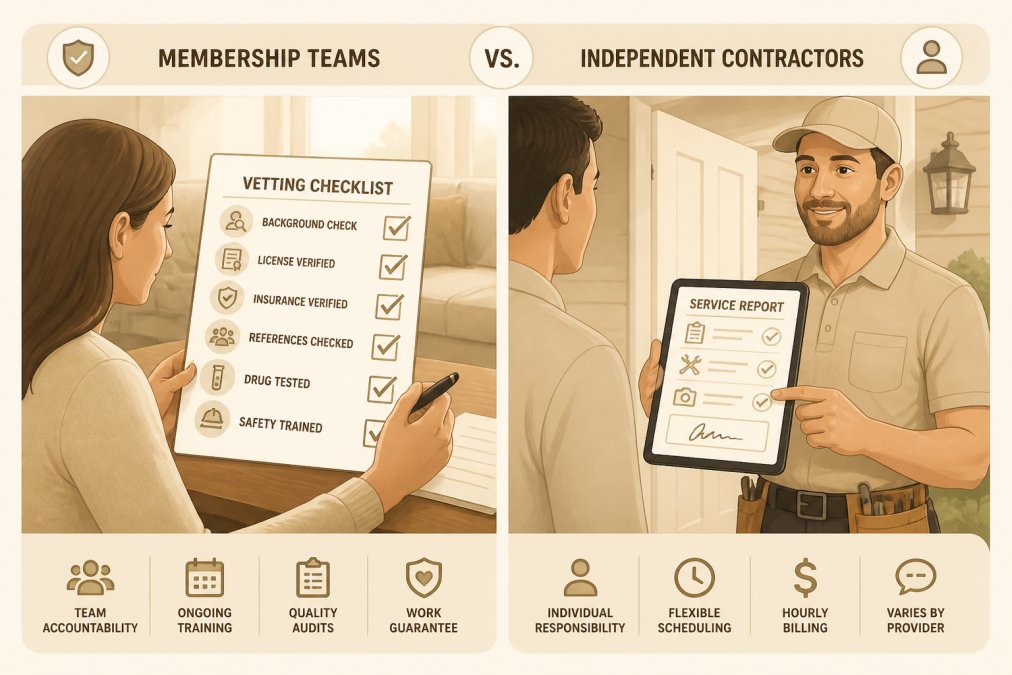
The stress of managing multiple contractors, wondering if they'll show up, worrying about quality, and handling disputes is real. A membership eliminates that stress by making accountability structural rather than dependent on your ability to vet and manage individual professionals.
For homeowners who enjoy the hands-on process and have time to thoroughly vet contractors, independent professionals can work well. For those who want accountability built into the system, membership provides it automatically.
Subscription vs On-Demand: Which Model Protects Your Property Best
Understanding membership vs service professionals means recognizing that the subscription model and on-demand model serve different purposes, and conflating them misses the real trade-off.
On-demand means you call when you need something. It's flexible. It's only paid when you use it.
Subscription means you pay a flat rate and get scheduled service plus the ability to request repairs when needed. You're paying for predictability and proactive care, not just reactive fixes.
Which protects your property better? Subscription does, because protection requires prevention. You can't prevent problems by reacting to them.
The real comparison is between subscription and neglect, not subscription and on-demand. Most homeowners who choose on-demand end up neglecting preventative work entirely because they don't remember to schedule it.
Which Option Is Right for Your Home
This decision comes down to three questions.
Second: How much risk are you comfortable taking with reactive repairs? Some homeowners are fine with the gamble that nothing major will break. Others want to prevent expensive failures.
Third: What's your actual cost tolerance? Membership costs money upfront as a predictable monthly expense.
For most homeowners, especially those who value their time, want accountability, and prefer prevention over crisis management, a membership model like Lone Eagle Home Services makes sense.
For homeowners who are hands-on, home-focused, and comfortable managing multiple contractors, independent professionals work fine.
The key is making an intentional choice based on what actually matters to you, not defaulting to whichever option feels cheaper at first glance.
Frequently Asked Questions
Why would I pay a membership fee when I can just call my regular contractor when something breaks?
A membership model shifts your approach from reactive repairs to preventative maintenance. When small issues are caught early through seasonal inspections, you avoid costly emergency repairs. A dedicated team also eliminates the time you spend coordinating multiple contractors, managing schedules, and chasing down availability. The real value is reliability and peace of mind, your home receives regular professional oversight rather than waiting for something to fail.
How does a home maintenance membership cost compare to hiring contractors individually?
Membership pricing depends on service scope and frequency. Most memberships bundle seasonal tune-ups, on-demand repairs, and vendor coordination into a flat-rate structure, which provides budget predictability. Individual contractors charge per job, so costs vary widely and can spike during peak seasons or emergencies. Memberships can offer value over a year when you factor in preventative care that stops expensive problems before they start.
Do I need preventative seasonal tune-ups if my house is newer and well-maintained?
Yes. New homes still require seasonal maintenance, HVAC filter changes, gutter cleaning, and weatherization prevent deterioration. Seasonal inspections catch issues like roof leaks, foundation cracks, or plumbing problems early, when they're cheap to fix. Waiting until something breaks guarantees a higher repair bill. Newer homes benefit most from preventative care because early intervention stops small issues from becoming structural problems.
Is a membership worth it if I'm only at my home six months a year?
Absolutely. Part-time homeowners benefit significantly from membership services. Seasonal winterization and property monitoring happen on schedule whether you're present or not. A dedicated team handles maintenance coordination, vendor oversight, and emergency response without requiring your direct involvement. This is especially valuable for vacation homes, where deferred maintenance during off-season months can lead to costly damage like frozen pipes or mold.
What happens if something goes wrong with work a membership service completes, who's liable?
Reputable membership-based services provide guarantees on their work and carry liability insurance. Your contract should clearly define warranty terms, response times for issues, and how disputes are resolved. Licensed and insured providers stand behind their work with documented service reports and follow-up inspections. This accountability is a key advantage over independent contractors who may be harder to reach if problems arise after the job is done.
Managing your home shouldn't mean juggling multiple contractors and hoping nothing breaks. Lone Eagle Home Services provides the membership-based approach that eliminates this stress. Our dedicated team handles your seasonal tune-ups, on-demand repairs, and vendor coordination with flat-rate pricing, digital service reports, and the accountability that independent contractors simply can't match. See our plans and discover how a membership model protects your property while simplifying your life.