 how-to
Finding Reliable Home Repair Professionals: A Guide
Table of Contents
- What You'll Need Before You Start Your Search
- How to Verify Contractor Insurance and Licensing
- Key Questions to Ask a Contractor Before Hiring
- Finding a Handyman Near Me Within 5 Mi: What to Check
- Red Flags That Signal an Unreliable Home Repair Professional
- Benefits of Membership-Based Home Maintenance
- Making the Final Decision: A Framework for Finding Reliable Home Repair Professionals
- Frequently Asked Questions
Last Updated: September 12, 2026
What You'll Need Before You Start Your Search
Finding reliable home repair professionals starts long before you make the first phone call. The homeowners who avoid bad contractors are the ones who prepare a short verification file in advance, so every candidate gets measured against the same standard instead of a gut feeling.
Before you contact anyone, assemble these five items:
- A written scope. List every task you want done, room by room. Vague scopes invite vague bids.
- A budget range. Know your ceiling before a contractor helps you set it.
- Your state's licensing lookup page. Most states publish contractor license status online.
- A document checklist. License number, insurance certificates, and a written estimate for each candidate.
- A shortlist of three. Never hire the first name you find.
That last point matters more than it sounds. A common mistake is treating the search as a race. It isn't. It's a comparison exercise, and you can't compare a sample of one.
How to Verify Contractor Insurance and Licensing
Verification is the single step most homeowners skip, and it's the one that protects you financially. A contractor's license number and insurance certificates are checkable facts, not claims to take on faith.
Start with licensing. Most states run a public lookup through a contractor licensing board or consumer affairs office, and state consumer protection offices directory can point you to the right agency. Search the business name and the individual's name. Confirm the license is active, not expired or suspended, and that the license class covers the work you're hiring for. A handyman license and a general contractor license are not interchangeable.
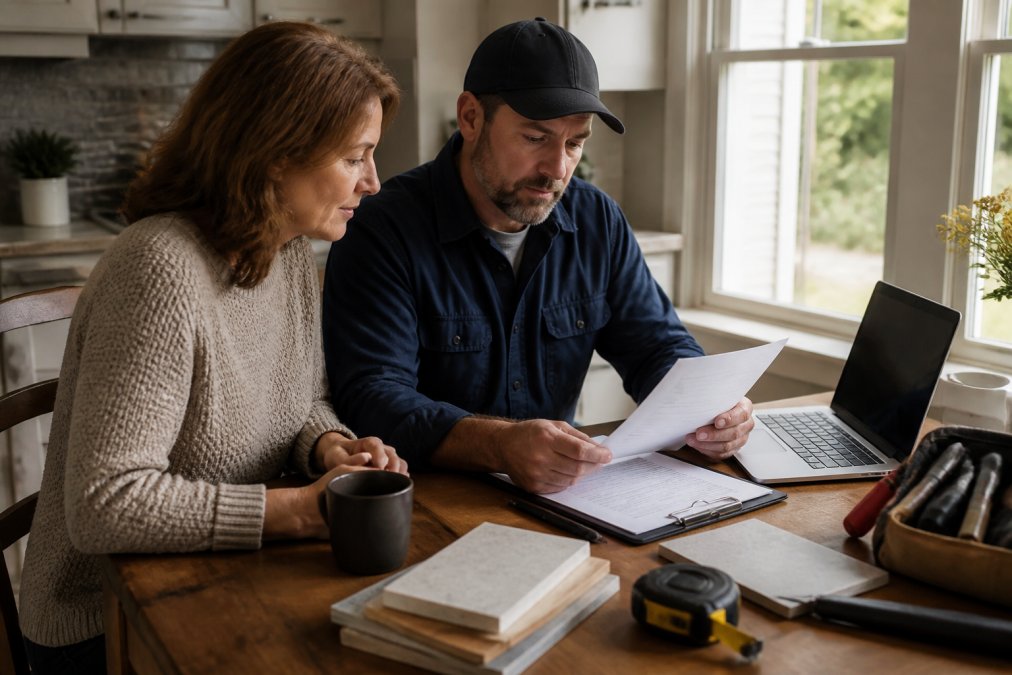
Then verify insurance. Ask for two documents: general liability insurance and workers' compensation coverage. Call the insurer directly using the number on the certificate, not the number the contractor gives you, and confirm the policy is current. This five-minute call is the difference between a covered accident and a lawsuit naming you as the defendant.
Key Questions to Ask a Contractor Before Hiring
The questions you ask a contractor before hiring reveal more than the answers do. How someone responds to a skeptical homeowner tells you exactly how they'll behave when a problem comes up mid-project.
Ask these, and listen for specifics rather than reassurances:
- "What's your license number, and who is your insurance carrier?" A professional answers instantly.
- "Who will actually be on site?" You want to know if the owner shows up or a rotating crew does.
- "What's your payment schedule?" Deposits over a third of the job total are a warning sign (consumer.ftc.gov).
- "How do you handle change orders?" The answer should involve written approval.
- "Can you provide three recent references for similar work?" Recent and similar, not ancient and unrelated.
- "What's your warranty on labor?" Get the length and what it covers in writing.
A reliable contractor will welcome this list. Someone who gets defensive about basic verification questions is telling you something useful.
Finding a Handyman Near Me Within 5 Mi: What to Check
Searching for a handyman near me within 5 mi narrows your options fast, and that's the point. Proximity affects response time, emergency availability, and how quickly someone can return for warranty work.
When you evaluate local candidates, check four things beyond the standard license and insurance review:
- Service radius in writing. Confirm the business actually covers your address, not just your zip code's edge.
- Response time for non-emergencies. Ask how many days out they're typically booked.
- Local reviews with dates. A cluster of recent reviews matters more than a high count from years ago.
- Physical business presence. A verifiable local address and phone number beat a listing that exists only on a lead-generation app.
Here's the honest trade-off with proximity: the closest option isn't automatically the best one. A slightly farther contractor with clear systems, confirmed appointments, and a real warranty will save you more time over a year than a neighbor who's cheap but unreliable.
Red Flags That Signal an Unreliable Home Repair Professional
Most unreliable contractors announce themselves early. The signals are consistent, and homeowners who learn to read them avoid the expensive lessons.
Watch for these:
- Cash-only payment demands. No paper trail means no recourse.
- Large upfront deposits. A request for half the job total before materials arrive is a classic exit strategy.
- Pressure to decide today. Legitimate businesses don't expire at midnight.
- No written estimate. Verbal quotes are unenforceable and easy to revise upward.
- Reluctance to provide a license number. This is the clearest signal of all.
- No physical address or only a cell number. Hard to serve papers on a phone.
- Vague answers about who's doing the work. Subcontracted labor without disclosure means unverified insurance.
One flag alone might be explainable. Two or more together, and you should walk away regardless of price.
Benefits of Membership-Based Home Maintenance
Membership-based home maintenance replaces the scramble of finding a different contractor for every task with one accountable team on a scheduled plan. Instead of reacting to breakdowns, members get seasonal tune-ups that catch small problems before they become expensive ones.
The practical benefits stack up quickly:
- One point of contact for repairs, tune-ups, and vendor coordination, so you stop juggling five phone numbers.
- Flat-rate pricing that removes the estimate-then-revise cycle from every job.
- Priority scheduling when something urgent happens, because you're already a known customer.
- Documented service reports after each visit, giving you a maintenance record that's useful at resale.
- Proactive seasonal work that addresses the systems most likely to fail in the coming months.
For homeowners who travel or spend part of the year elsewhere, the value is even clearer. A vacant house with a slow leak or a clogged gutter doesn't wait for your return. Lone Eagle Home Services provides uniformed technicians, confirmed appointments, and a single trusted team handling the property year-round rather than a rotating cast of independent contractors.
That's the structural difference. Traditional hiring puts the coordination burden on you. A membership moves it to the provider.
Making the Final Decision: A Framework for Finding Reliable Home Repair Professionals
Use a weighted scorecard to compare finalists instead of deciding on price alone. Score each candidate from 1 to 5 on the criteria below, multiply by the weight, and total the results. The highest score wins, and you'll have documented reasons for your choice.
| Criterion | Weight | What to Score |
|---|---|---|
| License and insurance verified | 25% | Active license, current liability and workers' comp |
| Written estimate clarity | 20% | Line-item scope, materials, timeline, payment terms |
| References and recent reviews | 20% | Three recent similar jobs, consistent feedback |
| Communication and responsiveness | 15% | Answer speed, follow-through on promised documents |
| Warranty and accountability | 10% | Written labor warranty, named point of contact |
| Price within budget | 10% | Total cost relative to your stated range |
A contractor who scores 5 on license verification but 2 on communication is a risk, not a bargain. The weighting exists because the criteria aren't equally important: a cheap estimate from an uninsured contractor is the most expensive option on the table.
Finding reliable home repair professionals comes down to process, not luck. Verify the paperwork, ask the uncomfortable questions, check the references, and score the finalists against a standard you set before anyone quoted you a number.
Frequently Asked Questions
What questions should I ask before hiring a home repair professional?
Ask for their full name, business address, and phone number. Request proof of licensing and insurance, and ask for three recent local references. Inquire about their process for written estimates, payment schedules, and warranty on work. Ask how they handle unexpected issues and whether they use subcontractors. A reliable professional will answer these without hesitation and provide documentation.
How can I verify a contractor's license and insurance?
Ask for their license number and insurance certificate. Contact your state's licensing board to confirm the license is active and in good standing. Call the insurance company directly to verify the policy covers general liability and workers' compensation. For home repair professionals, ensure the policy lists your state as a covered location. Never accept a photocopy as proof; call the insurer yourself.
What are the red flags of an unreliable home repair service?
Warning signs include demanding full payment upfront, no written contract, no physical business address, unwillingness to provide references, and pressure to decide immediately. Other red flags: they only accept cash, they can't show proof of insurance, or they offer a price that's significantly lower than others. Trust your instincts if something feels off, and always get everything in writing.
Is it better to hire a general handyman or a specialized contractor?
It depends on the job. A general handyman is fine for small tasks like patching drywall or fixing a leaky faucet. For electrical, plumbing, HVAC, or structural work, hire a licensed specialist. Some states require specific licenses for jobs over a certain dollar amount. When in doubt, ask the professional if they are licensed for that type of work. A membership-based service can coordinate both.
The real challenge isn't finding someone who can swing a hammer. It's finding a team that shows up when promised, documents what they did, and stands behind the work a year later. Lone Eagle Home Services handles that coordination for homeowners through a membership model built on flat-rate pricing, proactive seasonal tune-ups, and a single trusted team backed by confirmed appointments and digital service reports after every visit. See Plans and hand the maintenance list to someone accountable.