 how-to
A Seasonal Home Maintenance Checklist for Beginners
Last Updated: November 1, 2026
Quick Summary
Seasonal home maintenance is the practice of inspecting and servicing a home on a repeating yearly cycle, timed to the weather, so small problems get caught before they grow. Group tasks by season and repeat the same list every year, starting with spring inspection, summer exterior care, fall winterization, and winter indoor safety.
- Spring is inspection season: check the roof, gutters, foundation, and schedule an AC tune-up.
- Fall is winterization season and the most important block on the calendar.
- Never climb onto a roof or open a gas appliance yourself as a beginner.
- A Tier 1 starter tool kit costs $50 to $100 and handles filters, detectors, and caulk.
- Budget roughly 35% for spring, 15% summer, 35% fall, and 15% winter.
Table of Contents
- Why Seasonal Home Maintenance Matters for New Homeowners
- Your Home Maintenance Checklist by Month
- DIY Home Maintenance Tasks Beginners Can Handle Safely
- Home Maintenance Tools for Beginners: A Starter Kit
- Seasonal Home Maintenance Costs and How to Budget
- When to Call a Professional Instead of DIY
- How a Maintenance Membership Simplifies Seasonal Care
- See Plans and Schedule Your First Seasonal Tune-Up
- Frequently Asked Questions
Why Seasonal Home Maintenance Matters for New Homeowners
A seasonal home maintenance checklist for beginners turns a year of vague worry into a short list of tasks you can actually finish.
Why does timing matter so much? A gutter that clogs in October causes an ice dam in January and a rotted fascia board by April. USDA home maintenance guidance makes the same point: most costly damage starts as a task someone skipped.
New homeowners get hit hardest because nobody handed them a schedule, and a new house feels finished, so maintenance feels optional.
Below, we break the year into four blocks, list the tools you need, and show where DIY stops and a pro should start.
Your Home Maintenance Checklist by Month
The easiest way to run a home maintenance checklist by month is to group tasks by season and repeat the same list every year.
Here is the full year at a glance:
| Season | Main Focus | Key Tasks | Frequency |
|---|---|---|---|
| Spring | Thaw and inspect | Roof, gutters, foundation, AC tune-up | Once, in March to May |
| Summer | Exterior and cooling | Power washing, caulking, lawn care, filter swaps | Monthly through summer |
| Fall | Winterization | Gutter cleaning, heating check, weatherstripping | Once, in September to November |
| Winter | Indoor safety and freeze protection | Pipes, smoke alarms, heating filters, storm prep | Monthly through winter |
For a deeper walkthrough of building and tracking a repeating schedule, see our guide on how to create a seasonal home maintenance schedule.
Spring: Thaw, Inspect, and Repair
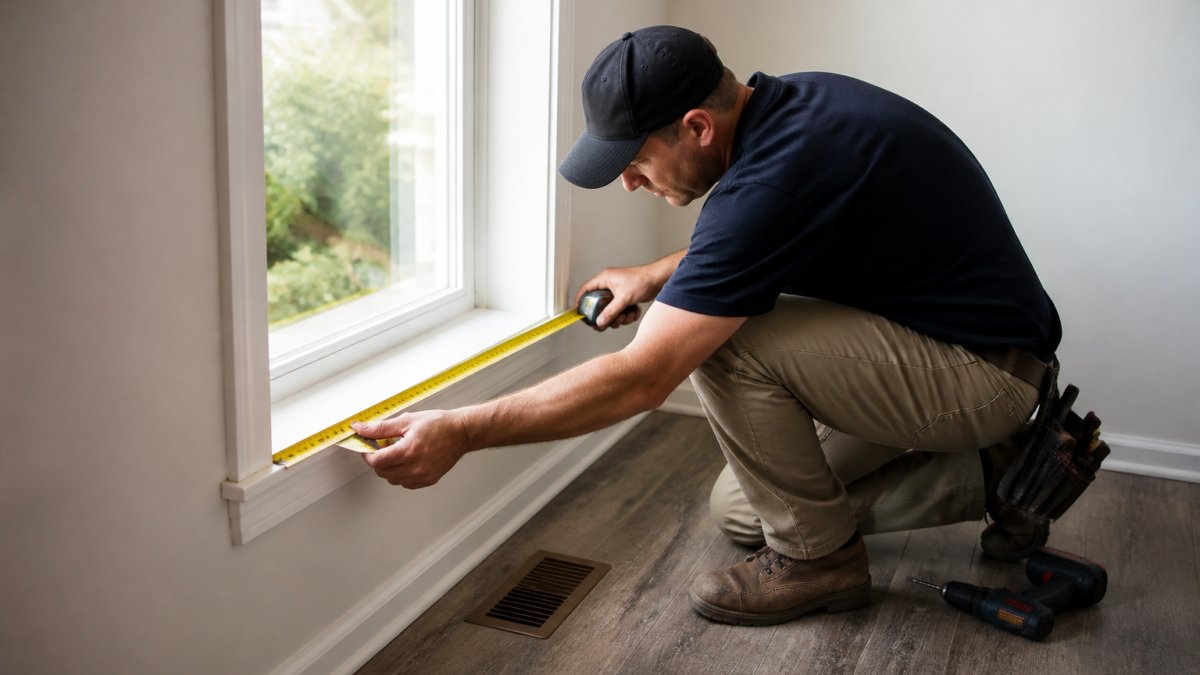
Spring is inspection season. Freeze-thaw cycles move soil, stress roofs, and open gaps. Walk the exterior after the last hard freeze and look for loose shingles, cracked caulk, and soil piled against the foundation.
Inside, change the HVAC filter, test smoke and carbon monoxide alarms, and schedule an AC tune-up before the first hot week. Check under sinks for leaks and run water in unused drains.
Summer: Exterior and Cooling System Care
Summer is when the home exterior takes the most abuse from sun, heat, and storms.
- Power wash siding and decks
- Re-caulk windows and doors
- Clean dryer vent and check the exterior vent flap
Fall: Winterization and Gutter Prep
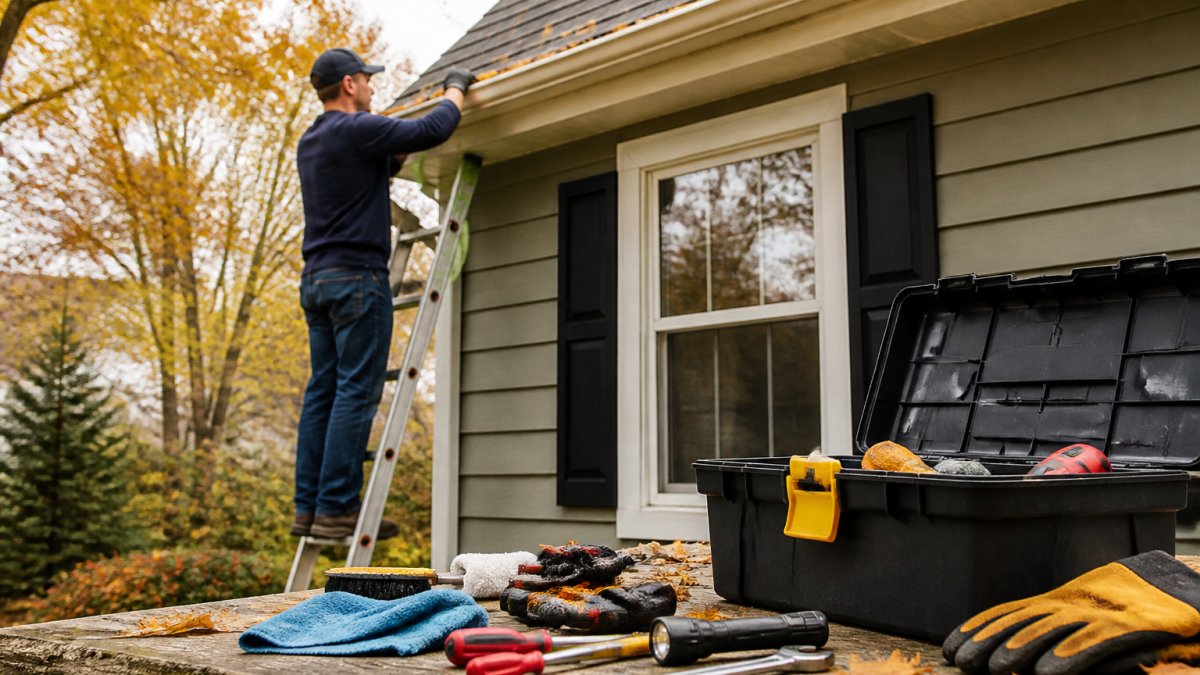
Fall is winterization season, and the most important block on the calendar. Gutter cleaning tops the list: clear leaves, flush the downspouts, and confirm water runs away from the foundation.
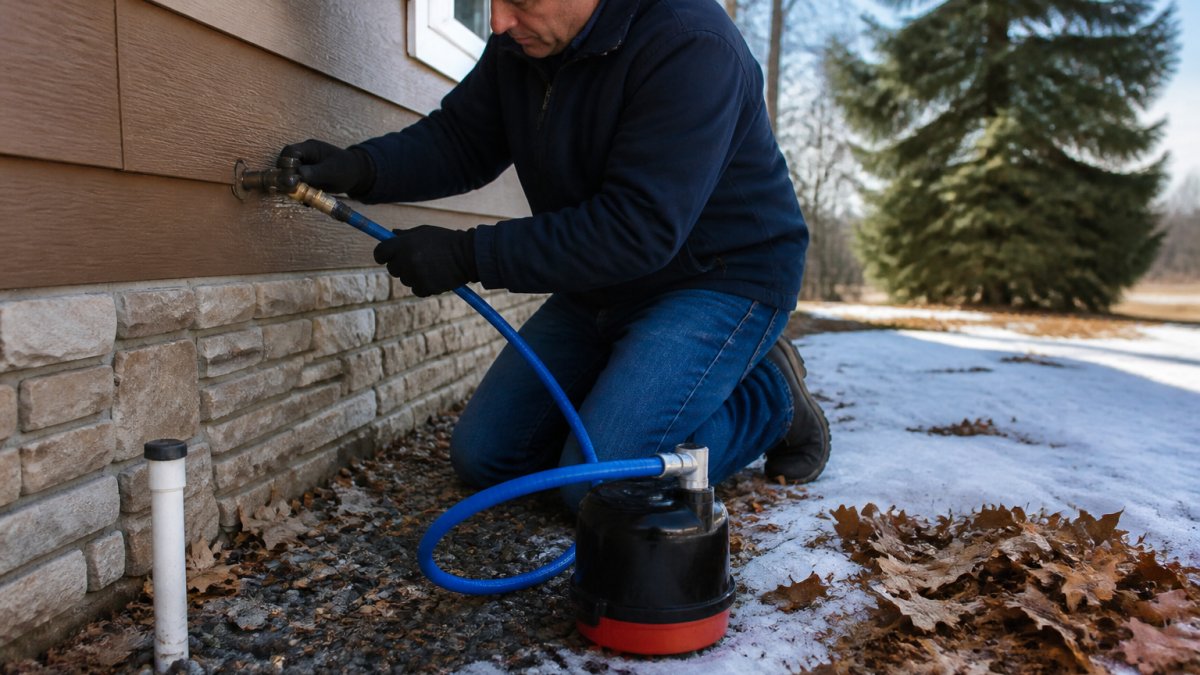
Next, have the heating system serviced, seal gaps with caulking and weatherstripping, and drain outdoor hoses. Check the roof for loose shingles before snow arrives, and check attic insulation.
Winter: Indoor Safety and Freeze Protection
Winter shifts the work indoors. Protect pipes in cold zones, know where the main water shutoff is, and keep cabinet doors open on exterior walls during deep freezes.
Test smoke detectors and carbon monoxide alarms again. Clean or replace furnace filters monthly. Keep a checked fire extinguisher reachable. Storm prep means salt, sand, and a plan for power loss.
DIY Home Maintenance Tasks Beginners Can Handle Safely
Most routine tasks are within reach for a beginner. The trick is knowing which ones, and stopping before a small job becomes a big one.
Safe starter tasks:
- Replacing HVAC filters and furnace filters
- Testing smoke detectors and carbon monoxide alarms
- Cleaning gutters from the ground with a hose extension
Watch out: never climb onto a roof or open a gas appliance yourself. Those are the two beginner mistakes that cause real injuries.
Home Maintenance Tools for Beginners: A Starter Kit
A home maintenance tools for beginners kit is the difference between a checklist you finish and one you abandon by April.
Tier 1: The $50-$100 Starter Kit
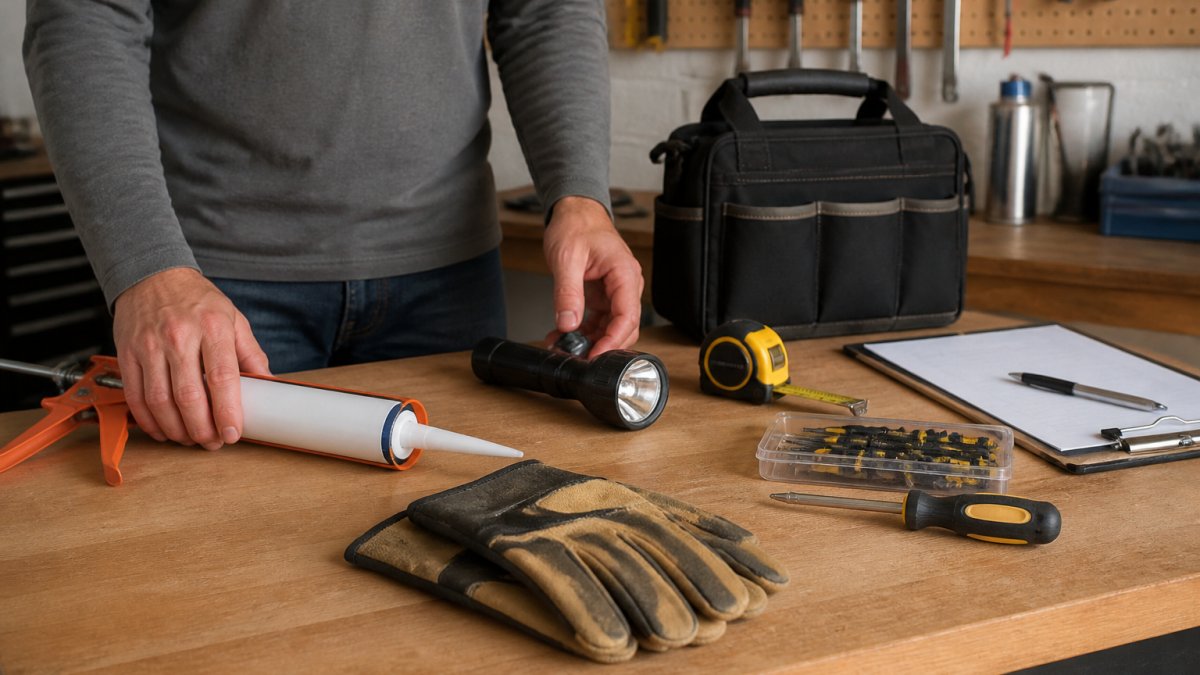
Buy these first. They handle filters, detectors, caulk, weatherstripping, and most indoor checks.
- Cordless drill/driver with a bit set, $40-$80. You will use it for hanging, tightening, and driving screws into studs. A 12V or 20V model from a major brand is plenty for a beginner.
- Screwdriver set (flat and Phillips, multiple sizes), $10-$20. Loose cabinet hinges, outlet covers, and furnace panels all need one.
- Adjustable wrench and slip-joint pliers, $15-$30 combined. For supply lines, showerheads, and drain fittings.
Tier 2: Add in the First Year ($100-$200 total)
- Shop vacuum, $50-$100. Gutter debris, dryer lint, and post-project cleanup.
- Hose nozzle with a shutoff, $10-$20. For gutter flushing from the ground and rinsing siding.
- Bucket, sponge, and scrub brush, $15-$25. For AC condensate pans, drain traps, and general cleaning.
- Voltage tester (non-contact), $15-$25. Confirms a circuit is dead before you touch a switch or outlet cover.
What to Skip (For Now)
Do not buy a pressure washer, a ladder taller than a step ladder, a full socket set, or any gas-powered tool until a specific task demands it. Rent a pressure washer for an occasional job rather than buying one, and leave roof access to a professional.
Matching Tools to Tasks
| Task | Tool You Need | Tier |
|---|---|---|
| Change HVAC filter | None (or gloves) | 1 |
| Test smoke/CO alarms | Step ladder, spare batteries | 1 |
| Caulk a window gap | Caulk gun, exterior caulk, scraper | 1 |
| Flush the water heater | Hose, wrench, bucket | 1-2 |
| Clean the dryer vent | Shop vacuum, vent brush | 2 |
| Flush gutters from the ground | Hose nozzle, gloves, glasses | 2 |
If you want a step-by-step system for building your own list around the tools you own, our guide on how to create a home maintenance checklist walks through tools, seasonal tasks, and organization.
Seasonal Home Maintenance Costs and How to Budget
Seasonal home maintenance costs determine whether you actually do the work. A checklist without a budget is a wish list.
The 1% Rule, and Its Limits
A common starting point is the 1% rule: set aside roughly 1% of your home's value each year for maintenance. It's a useful anchor, not a law, treat 1% as a floor, not a ceiling.
What Individual Tasks Actually Cost
These are typical ranges for common seasonal tasks. Your numbers will vary by home size, age, and local labor rates.
| Task | DIY Cost | Typical Pro Cost |
|---|---|---|
| HVAC filter (each) | $10-$30 | n/a |
| AC tune-up (spring) | n/a | $75-$150 |
| Furnace tune-up (fall) | n/a | $80-$150 |
| Gutter cleaning (single story) | $0-$20 in supplies | $100-$250 |
| Water heater flush | $0-$15 | $100-$200 |
| Dryer vent cleaning | $0-$20 | $100-$175 |
| Caulk and weatherstripping | $20-$50 | $150-$400 |
| Smoke/CO alarm replacement | $15-$40 each | n/a |
| Roof inspection | n/a | $150-$400 |
Two patterns stand out. The DIY-versus-pro gap is often $100-$300 per task, so a starter tool kit pays for itself in one season. And the biggest line items (HVAC service, gutter cleaning, roof inspection) cluster in spring and fall.
Budget by Season, Not by Year
A single annual number is hard to plan around. Break it into four buckets instead:
- Spring (heaviest): AC tune-up, gutter cleaning, exterior inspection. Budget the largest share here.
- Summer (light): Filters, caulk, lawn supplies. Mostly consumables.
- Fall (heaviest): Furnace tune-up, gutter cleaning again, weatherstripping, roof check. Second-largest share.
- Winter (light): Filters, alarm batteries, pipe insulation. Small supplies.
A practical split is roughly 35% spring, 15% summer, 35% fall, 15% winter. Adjust to your climate, a cold-winter region shifts more weight to fall.
Build a Sinking Fund
A sinking fund is a dedicated savings account you feed monthly for known future expenses. Divide your annual maintenance target by 12 and automate the transfer. On the $3,500 example, that's about $290 a month. When the fall furnace tune-up and gutter cleaning land in the same week, the money is already there.
Track What You Actually Spend
A budget you don't measure drifts. Keep a simple log, spreadsheet or notebook, with four columns: date, task, DIY or pro, cost. After one full year you'll know your real number. For a template, see our guide on how to calculate your annual home maintenance budget.
When to Call a Professional Instead of DIY
Call a professional when a task involves height, gas, major water, or the structural shell of the home. Those four categories are where beginner repairs go wrong.
Hire out:
- Roof work and anything above a step ladder
- Gas lines, furnaces, and water heaters
- Electrical panel work and new wiring
- Foundation cracks and structural repairs
Watch out: a garage door spring can cause serious injury if it lets go. Leave it to a trained technician.
Not sure where your limits are? Our guide on how to know when to call a professional for home repairs covers the warning signs that a job is out of DIY range.
How a Maintenance Membership Simplifies Seasonal Care
Most homeowners do not fail at maintenance because they are lazy. They fail because the list lives in five places and nobody owns it.
A maintenance membership fixes that by putting one team on the schedule.
Flat-rate pricing, priority scheduling, and member-exclusive labor rates are part of the membership.
For a homeowner juggling three contractors and a full-time job, that is the real value: fewer calls, fewer surprises, and a home cared for on time.
See Plans and Schedule Your First Seasonal Tune-Up
The hardest part of a seasonal home maintenance checklist for beginners is starting. Pick one season, run the list once, and see how much you catch.
If you would rather hand the schedule to a team that shows up, confirms appointments, and reports back after every visit, our membership covers seasonal tune-ups, on-demand repairs, and vendor coordination under flat-rate pricing, with priority scheduling and digital service reports.
See Plans to schedule your first seasonal tune-up. Your future self, the one not paying for an emergency repair, will thank you.
Frequently Asked Questions
What home maintenance should beginners do each season?
Beginners should focus on a short list per season. In spring, check the roof, clean gutters, and test smoke detectors. Summer calls for AC filter changes and exterior washing. Fall means winterization: caulking, weatherstripping, and flushing the water heater. Winter is for indoor safety checks like carbon monoxide alarms and pipe insulation. A seasonal home maintenance checklist keeps these tasks from piling up, and spacing them out makes each one manageable for a first-time owner.
Which home maintenance tasks can beginners do themselves?
Safe DIY home maintenance tasks include replacing HVAC filters, testing smoke detectors and carbon monoxide alarms, cleaning gutters from the ground with a hose attachment, caulking small gaps, weatherstripping doors, flushing the water heater, and cleaning the dryer vent. Skip anything involving gas lines, electrical panels, roof work above one story, or garage door springs. Those require licensed professionals, and a beginner injury or botched repair usually costs more than hiring help.
What tools do beginners need for basic home maintenance?
A starter kit covers most seasonal tasks: a screwdriver set, adjustable wrench, tape measure, caulk gun and caulk, flashlight, work gloves, safety glasses, a bucket, and a hose with a spray nozzle. Add a furnace filter sized to your unit and a basic drain snake. These items handle the majority of a seasonal home maintenance checklist without a professional visit.
When should you hire a professional for home maintenance?
Call a professional for HVAC servicing, roof inspections and repairs, electrical work, plumbing behind walls, gas appliances, and any task requiring a ladder above one story. Also hire out when a DIY fix has failed twice. A membership service can bundle these visits and coordinate vendors, which removes the guesswork for beginners.
Ready to stop chasing contractors and start preventing problems? Get started with Lone Eagle Home Services and put your home on a schedule that actually holds.