 listicle
Signs Your Rental Property Needs Professional Maintenance: A Landlord's Guide
Last Updated: November 2, 2026
Quick Summary
Signs your rental property needs professional maintenance include visible water damage or mold, roof and exterior seal failures, recurring plumbing leaks, declining heating and cooling performance, and foundation cracks or unexplained utility bill increases. Walk the property twice a year and act quickly on any sign that is growing, recurring, or has no obvious cause.
- Check ceilings, under sinks, around windows, near the water heater, and along the roofline at least twice a year.
- Cracks wider than about 1/8 inch, or ones that grow over three months, warrant a structural evaluation.
- Three consecutive months above the prior year's utility baseline is a pattern worth investigating.
- Repeated calls to clear the same drain are a clear sign to bring in a plumber.
- Refrigerant, gas, and panel electrical work should go to a licensed trade, not DIY.
Table of Contents
- Why Landlords Miss the Warning Signs Until Repairs Get Expensive
- Visible Water Damage, Moisture, and Mold Growth
- Roofing, Gutter, and Exterior Seal Problems
- Plumbing Leaks, Drainage Problems, and HVAC Decline
- Foundation Cracks and Rising Utility Bills as Red Flags
- Landlord Maintenance Responsibilities: What You Owe Tenants
- Building a Rental Property Maintenance Checklist and Cost Plan
- Booking a Professional Maintenance Visit for Your Rental
- Frequently Asked Questions
Most landlords don't notice that their rental property needs professional maintenance until a small problem has already become an expensive one. A slow drip under a sink, a faint ceiling stain, or a tenant mentioning a funny smell can all signal trouble. This guide covers the signs that call for a professional, what you can check yourself, and how to plan maintenance.
Why Landlords Miss the Warning Signs Until Repairs Get Expensive
Landlords miss early warning signs because they are busy, the property is not their home, and tenants often wait before reporting problems. A minor leak can run for months before anyone sees it, and by the time damage shows, the repair is far larger than it needed to be.
Walk through the property at least twice a year and check for signs your rental property needs professional maintenance in the places most likely to fail: ceilings, under sinks, around windows, near the water heater, and along the roofline. You can spot the early warning signs of roof failure before damage spreads, with a checklist of what to look for and when to call a pro.
Watch out: waiting for a tenant to report a problem often means the damage has already spread. Ask tenants to report even small issues, and respond quickly.
Visible Water Damage, Moisture, and Mold Growth
Water damage is one of the most common reasons a rental needs professional attention. Look for stains on ceilings, bubbling or peeling paint, soft drywall, warped flooring, and a musty smell.
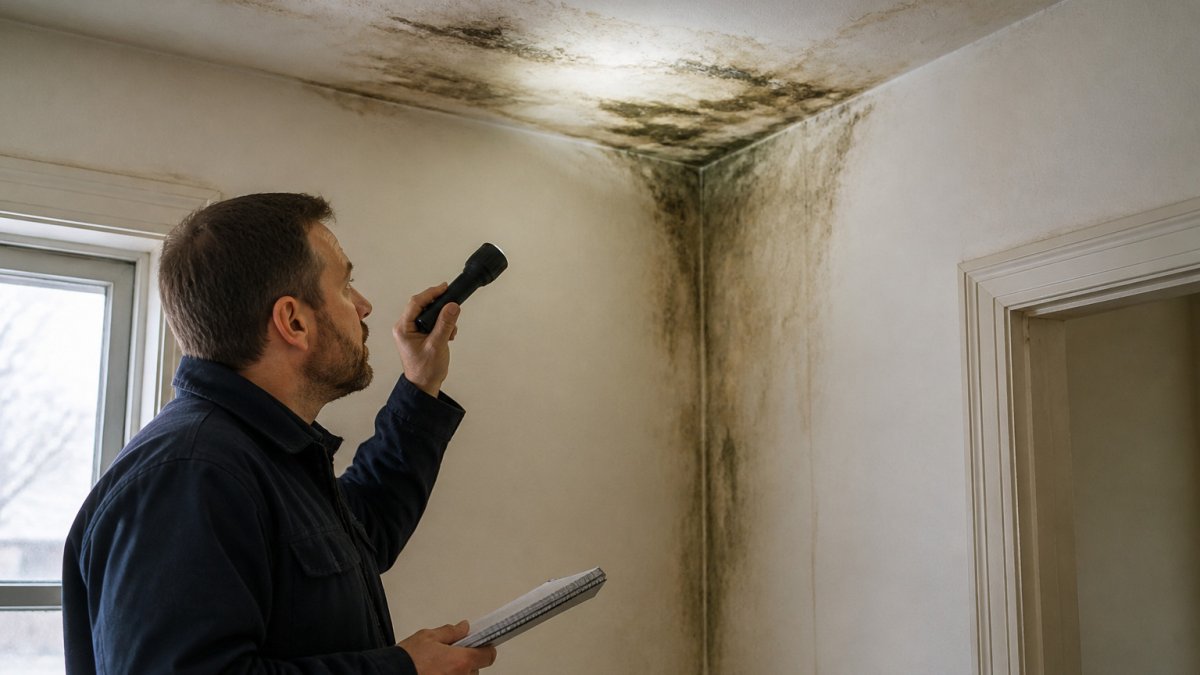
Mold is a serious sign. It grows where moisture has been trapped, so a patch of mold usually means there is a water problem behind it, and cleaning the surface alone will not solve the cause.
Hidden moisture can be harder to spot. A moisture meter can help you check drywall and baseboards for elevated readings.
Roofing, Gutter, and Exterior Seal Problems
The roof, gutters, and exterior seals protect the building from water, so problems here tend to cause damage inside.
Exterior seals also deserve attention. Cracked caulk around windows and doors, gaps in weather stripping, and failed sealant around siding or trim let water and air enter.
Watch out: do not climb onto a roof or a tall ladder alone to inspect it. Heights are a real safety risk.
If you spot a roof leak, the cost of waiting rises quickly. Read what happens if you ignore roof leaks to see the costly outcomes of delaying repair.
Plumbing Leaks, Drainage Problems, and HVAC Decline
Plumbing problems often start small. Check under sinks, around toilets, and at the base of the water heater for moisture or corrosion.
Heating and cooling systems wear out gradually. Signs of decline include uneven temperatures between rooms, longer run times, unusual noises, higher energy bills, and tenant reports that the system struggles on hot or cold days.
A common mistake is replacing a fixture or appliance over and over without asking why it keeps failing.
Foundation Cracks and Rising Utility Bills as Red Flags
Foundation movement and unexplained cost increases are two of the most overlooked warning signs because neither produces the dramatic visual that a ceiling stain does. Both develop slowly and are easy to attribute to something else, but the response to each is different.
Reading foundation cracks correctly
Not every crack matters. Hairline cracks in drywall or plaster, especially at inside corners or above door frames, are usually cosmetic and track back to normal settling or seasonal wood movement. For a practical routine and crack-width thresholds, see how to spot foundation cracks early. The cracks that warrant a structural evaluation share recognizable characteristics:
- Width and growth. A crack wider than about 1/8 inch, or one that measures wider in three months, is a different category from a hairline. Photograph it next to a coin or ruler so the comparison is objective.
- Stair-step pattern. Diagonal cracks that step along mortar joints in block or brick walls often follow the path of least resistance created by differential settlement.
- Horizontal cracks in a foundation wall. These can indicate soil pressure pushing inward and are generally more serious than vertical cracks.
Watch out: cosmetic patching of a growing crack hides the evidence a structural engineer needs. If you are unsure, document the crack and leave it visible until it has been evaluated.
A structural engineer, not a general handyman, is the right call for anything beyond cosmetic. The engineer's report also gives you documentation if the issue later becomes a disclosure item.
Using utility bills as a diagnostic tool
A rising utility bill is a symptom, not a diagnosis. The useful move is to isolate which utility is climbing and correlate it with the season and the unit.
- Gas or electric heat climbing in winter points toward a failing furnace, duct leakage, or insulation and air-sealing gaps. Compare the same month year over year, not month to month, because weather dominates the signal.
- Electric climbing in summer points toward an aging air conditioner, a refrigerant charge issue, or a duct system leaking conditioned air into an attic.
- Water climbing with no change in occupancy points toward a running toilet flapper, a dripping water heater, or an irrigation leak. Check the meter with all fixtures off; if the dial still moves, something is running.
A single anomalous bill is noise, while three consecutive months above the prior year's baseline is a pattern worth investigating. Keep twelve months of bills per unit so the baseline exists.
When it is a professional call versus a landlord check
A landlord can reasonably handle the meter test, the bill comparison, and photographing cracks. A licensed HVAC technician should handle refrigerant and combustion diagnostics; a plumber should handle anything beyond a flapper or a visible supply-line drip; a structural engineer should handle any crack that is growing, horizontal, or accompanied by sticking doors.
Landlord Maintenance Responsibilities: What You Owe Tenants
Landlord responsibilities vary by state and local law, so check the rules that apply to your rental in the United States jurisdiction where it is located.
Respond to urgent repairs quickly, and keep a written record of every request and the action taken. Good documentation protects both you and your tenants.
Vendor coordination is part of the job. When a repair needs a licensed trade, schedule it promptly, confirm the scope in writing, and follow up to confirm the work is done.
Building a Rental Property Maintenance Checklist and Cost Plan
A checklist only works if it is tied to a calendar and a decision rule. Most landlords already know they should clean gutters and service the furnace; the gap is knowing when in the year to do each task, what it typically costs, and whether it is a landlord job or a licensed-trade job.
A calendar-based inspection schedule
Rather than a static list, anchor each task to the season when the failure mode is most likely to appear or the consequence is most expensive.
Early spring (March-April)
- Walk the exterior for winter damage: cracked caulk, lifted shingles, shifted downspouts.
- Test the air conditioner before the first heat wave, when HVAC technicians are booked out.
- Check the sump pump and basement drainage before spring rain.
Late spring (May-June)
- Service the air conditioner: filter, coil cleaning, condensate drain. A clogged condensate line is a common cause of water damage in summer.
- Check exterior paint and siding for moisture intrusion.
- Test smoke and carbon monoxide detectors and replace batteries.
Early fall (September-October)
- Clean gutters after leaf drop; clogged gutters are a leading cause of fascia rot and basement water.
- Service the furnace before the first cold snap.
- Drain and winterize exterior hose bibs and irrigation.
Late fall (November-December)
- Confirm heat is working in every unit; a heat failure in December is an emergency repair at emergency pricing.
- Check weather stripping and door sweeps.
- Review the year's maintenance log and flag systems approaching end of life.
Monthly and quarterly
- Monthly: test detectors, check under sinks for moisture, look at the water heater base for corrosion.
- Quarterly: run water in unused fixtures to keep traps sealed, check the HVAC filter, and review tenant requests for patterns.
Cost benchmarks and reserve planning
Routine upkeep costs are predictable enough to budget. Many landlords set aside a maintenance reserve and adjust it based on their maintenance log after the first year.
Use your own vendor quotes to estimate routine and capital costs, because local labor rates vary substantially. For current pricing on Lone Eagle Home Services memberships, see our pricing information on our website.
The professional-versus-DIY decision rule
This is the part most checklists skip. A practical rule set:
- Landlord can handle: filter changes, detector testing, caulking, tightening visible supply-line fittings, clearing a sink trap, replacing a flapper, photographing and documenting.
- Licensed trade required: anything involving refrigerant, gas combustion, electrical panel work, drain-line snaking beyond a fixture trap, and any repair that requires a permit.
- Professional inspection warranted: any sign that is growing, recurring, or has no obvious cause. A second opinion on a $200 diagnostic is cheap against a $4,000 repair.
Watch out: DIY work on gas, refrigerant, or panel electrical can void warranties and may require a licensed contractor and a permit.
Digital tracking to turn the checklist into a predictive tool
A spreadsheet or property management app closes the loop. Log every request with date, unit, vendor, cost, and resolution. After a year or two, the log reveals which systems fail repeatedly, which units generate disproportionate requests, and which capital items are approaching replacement. Combine tenant-reported issues with your own walkthrough observations, because tenants notice drafts and daily-use failures while you notice structural and exterior changes.
The article's seasonal schedule summarises when each maintenance task should happen across the year.
| Season | Key tasks | Why now |
|---|---|---|
| Early spring (March-April) | Exterior walk, AC test, sump pump check, seal inspection | Winter damage shows; AC techs book up |
| Late spring (May-June) | AC service, siding check, detector tests | Condensate clogs cause summer water damage |
| Early fall (September-October) | Gutter cleaning, furnace service, winterize hose bibs, roof check | Clogged gutters cause rot; furnace before cold |
| Late fall (November-December) | Confirm heat works, check weather stripping, review log | Heat failure in December costs emergency rates |
| Monthly and quarterly | Detector tests, sink and heater checks, trap runs, filter changes | Catches small leaks and keeps traps sealed |
Booking a Professional Maintenance Visit for Your Rental
When the signs point to a problem beyond a simple fix, the next step is a professional visit.
Before you call, gather your notes, photos, and any tenant reports. Describe what you have seen, when it started, and whether it is getting worse.
To see how a membership plan could keep your rental property on schedule, visit our plans page.
Frequently Asked Questions
When is it time to outsource rental property repairs to professionals?
Call a professional when the problem involves structural elements, gas, electrical work, active water intrusion, or a system you cannot diagnose confidently. Roofing, foundation movement, HVAC failures, and recurring plumbing leaks generally warrant a licensed technician. Tasks like replacing a faucet washer or a cabinet hinge can usually stay in-house. If the same issue returns after a repair, that is a signal the root cause has not been found. Early professional inspection typically costs less than emergency repairs after damage spreads.
What is the difference between routine maintenance and emergency repairs?
Routine maintenance is scheduled, predictable work such as HVAC filter changes, gutter cleaning, caulking, and seasonal inspections. Emergency repairs are unplanned failures that need immediate attention, like a burst pipe or a failed water heater. Routine upkeep is usually cheaper per task and prevents many emergencies. Tracking both in a maintenance log helps you spot patterns, such as a water heater that fails every few years, and plan capital expenditures before they become urgent.
Are landlords legally required to perform preventative maintenance?
Federal law does not list specific preventative tasks, but most states require landlords to keep rental units habitable, which generally includes working heat, plumbing, and structural soundness. Requirements vary by state and city, so check your local housing code and your lease terms. Performing regular property inspections and documenting completed work protects you if a tenant later disputes a repair or files a habitability claim. This is general information, not legal advice; consult a local attorney for your situation.